
How does the brain construct reality?
Exploring active inference, interface theory, and how the mind minimizes prediction errors.

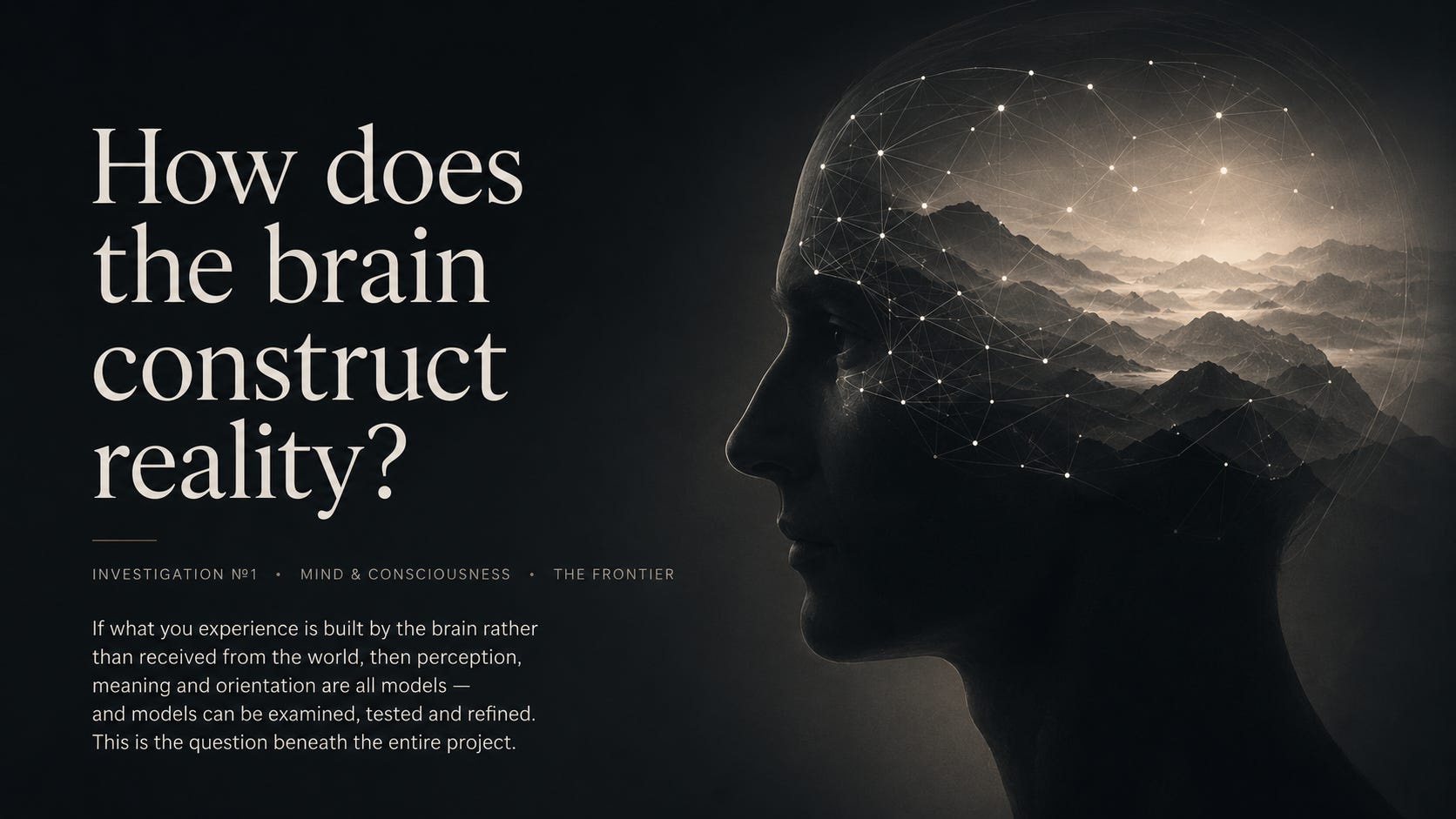
Investigation №1 · Mind & Consciousness · The Frontier
If what you experience is built by the brain rather than received from the world, then perception, meaning and orientation are all models — and models can be examined, tested and refined. This is the question beneath the entire project.
Confidence in the core claim: high (4/5) — strong convergent evidence; the mechanism and the link to consciousness are still contested.
What the evidence currently says
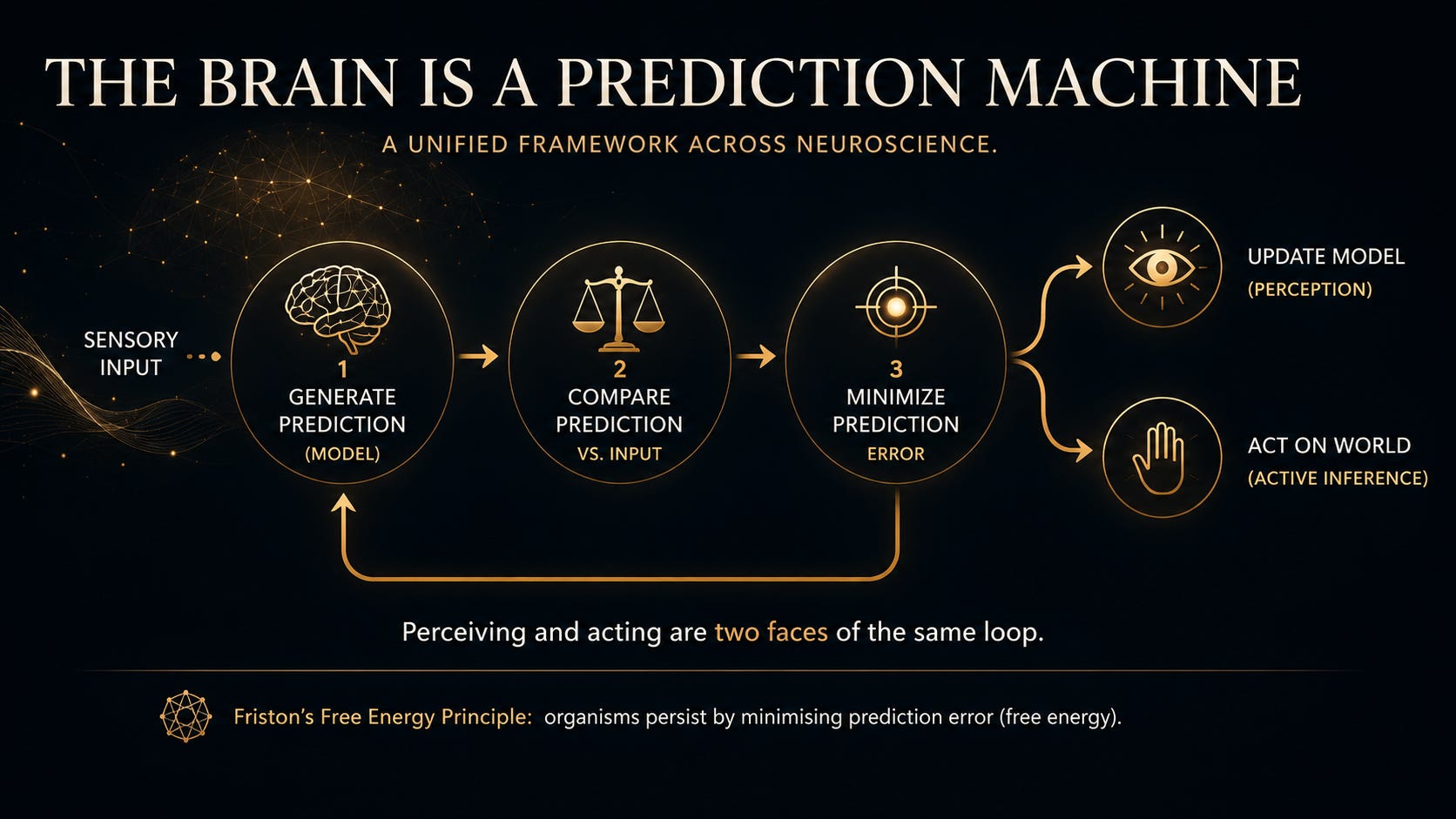
Across neuroscience, cognitive science and philosophy of mind, a dominant framework has formed: the brain is fundamentally a prediction machine. Rather than building experience bottom-up from raw sensory input, it runs a generative model — its best guess about the causes of its sensory stream — and uses incoming signals mainly to correct prediction errors. Perception, on this view, is a ”controlled hallucination” reined in by the world (Seth; Clark; Hohwy). Karl Friston’s Free Energy Principle formalises it: organisms persist by minimising prediction error (free energy), either by updating the model (perception) or by acting to make the world fit the model (active inference).
Strong / convergent. Predictive-coding architectures fit a wide range of perceptual phenomena (illusions, attention as precision-weighting, binocular rivalry) and map onto cortical hierarchy and feedback connectivity. The framework is unusually unifying — it reframes perception, action, attention, emotion and aspects of mental health under one principle.
What recently moved the field. A seven-year, preregistered adversarial collaboration (the Cogitate consortium) pitting Integrated Information Theory against Global Neuronal Workspace Theory reported in Nature, 30 April 2025 (n = 256; fMRI, MEG, iEEG). Conscious content decoded best from posterior cortex; prefrontal “global broadcast” was not necessary — pressuring workspace accounts. Crucially, neither theory was confirmed. The headline is methodological: theories of mind can be put to genuine, falsifiable test.
Why perception need not show you the truth
Two independent research programmes — one from neuroscience, one from evolutionary game theory — arrive at the same unsettling place: what you perceive is not a faithful readout of the world. They agree on that, and disagree sharply on what it means. That disagreement is where the frontier is.
1. Active inference — perception as the brain’s best guess
Active inference, developed by Karl Friston, treats the brain as a prediction machine running a generative model of the world. It does not assemble experience from raw sensory data flowing inward; instead it continuously generates its best inference about the hidden causes of its sensations, and uses the senses mainly to correct that model where it errs. Formally, the system acts to minimise prediction error (”variational free energy,” the gap between what it expects and what it senses). It can close that gap two ways: by updating the model (perception) or by acting on the world to make sensations match the prediction (action). Perceiving and acting become two faces of the same loop. So what you experience is a controlled construction, tuned to support useful inference and action — not to mirror reality faithfully.
2. Interface theory — evolution doesn’t select for truth
Donald Hoffman pushes the point further, from a different direction. With Chetan Prakash he proved what they call the Fitness-Beats-Truth (FBT) theorem: in evolutionary game-theoretic models, organisms whose perceptions are tuned to fitness reliably outcompete and drive to extinction those tuned to perceive objective reality as it is. In their simulations the probability that a truth-perceiving strategy survives natural selection rounds, strikingly, to roughly zero. Hoffman’s conclusion — his Interface Theory of Perception — is that our senses evolved like a *desktop interface: the icons are useful precisely because they hide the underlying machinery rather than reveal it. On this view, space, time and physical objects are species-specific data structures, not the furniture of reality.
Read this precisely: the “≈0%” is a result within a formal evolutionary model under stated assumptions, not an unconditional empirical fact. Its strength is the theorem; its limit is the modelling assumptions — which is exactly what a careful reader should interrogate.
The tension worth holding
Both theories agree perception is non-veridical — built for usefulness, not truth. But they part on the metaphysics. Friston’s active inference is broadly naturalist and physicalist: the brain is a physical organ modelling a physical world it cannot see perfectly. Hoffman runs the same non-veridicality against physicalism, arguing for “conscious realism” — that consciousness, not matter, is fundamental. Same premise, opposite conclusions. Resisting the urge to collapse that into one tidy story — and instead asking which assumptions drive the divergence — is the actual frontier work here.
What follows if this is true
The interesting move is not to summarise the science but to ask what it implies:
- Experience is editable at the level of the model, not the world. If perception is the brain’s best guess, then changing what you attend to, expect and believe changes what you literally perceive — the mechanism behind reframing, placebo, and why orientation precedes clarity.
- Suffering is often a prediction-error problem, not only an event problem. Much distress is the gap between a strong prior (how things “should” be) and life evidence. This reframes “healing” as model-revision rather than mood-management.
- Action and perception are one loop. We don’t just perceive then act — we act to confirm our models. Identity becomes self-fulfilling unless the loop is made visible.
These are interpretive implications drawn from the framework, not established experimental findings.
Where it’s contested
- Is the Free Energy Principle falsifiable? Critics argue it is so general it risks explaining everything and predicting nothing specific. Defenders reply that its process theories (predictive coding, active inference) do make testable predictions. Unresolved.
- Prediction ≠ consciousness. Predictive processing explains a lot about perception but does not say why any of it is experienced. The “hard problem” remains open.
- Competing maps. IIT, GNWT, higher-order theories and predictive-processing accounts are not yet reconciled. We have strong models of construction, weak consensus on experience.
---
Make this count as CPD (≈45 min)
Learning outcomes. After this investigation you should be able to: (1) explain the predictive-processing / active-inference account of perception; (2) state the Fitness-Beats-Truth result and its modelling caveats; (3) articulate why active inference and interface theory agree perception is non-veridical yet diverge metaphysically.
To complete the unit:
- Read the associated references — at least Friston (2010) and Hoffman, Singh & Prakash (2015), in full (linked below).
- Reflect (3–5 lines each): Where might my practice assume clients perceive their situation “as it is”? Which FBT modelling assumption would I most want to challenge? What is one prediction-error reading of a pattern I see in my work?
- Log it against your professional body’s CPD requirements.
Self-certified, CPD-eligible structured learning — not an endorsement by any statutory regulator. Log only genuine time spent. Certificate available to members.
---
Sources
1. Cogitate Consortium — “Adversarial testing of global neuronal workspace and integrated information theories of consciousness.” Nature, 30 Apr 2025. https://www.nature.com/articles/s41586-025-08888-1
2. Friston, K. — “The free-energy principle: a unified brain theory?” Nature Reviews Neuroscience (2010). https://www.nature.com/articles/nrn2787
3. Parr, T., Pezzulo, G. & Friston, K. — Active Inference: The Free Energy Principle in Mind, Brain, and Behavior (MIT Press, 2022).
4. Clark, A. — “Whatever next? Predictive brains, situated agents, and the future of cognitive science.” Behavioral and Brain Sciences (2013).
5. Seth, A. — Being You: A New Science of Consciousness (2021).
6. Hohwy, J. — The Predictive Mind (2013).
7. Hoffman, Singh & Prakash — “The Interface Theory of Perception.” Psychonomic Bulletin & Review (2015). https://link.springer.com/article/10.3758/s13423-015-0890-8
8. Prakash, C. et al. — “Fitness Beats Truth in the evolution of perception.” Acta Biotheoretica (2021). https://link.springer.com/article/10.1007/s10441-020-09400-0
9. Hoffman, D. — The Case Against Reality (2019).
---
Our standards: every investigation is built to be tested, not believed — claims are sourced, strong evidence is kept separate from contested evidence, competing theories and contradictions are shown rather than smoothed over, confidence is stated explicitly, and each piece names what would change its mind. A human reviews every word before it is published. Reality is the arbiter.
Join the Frontier
© 2026 David Fleming · Models of Reality / The Frontier. All rights reserved. Recursive Field Theory (RFT) is the original work of David Fleming. No part of this publication or the system that produces it may be reproduced, reverse-engineered or used to train or build a competing service without permission.